

Why OnlyFans Makes $ense
On broken promises, stagnant wages, and the market value of my feet.

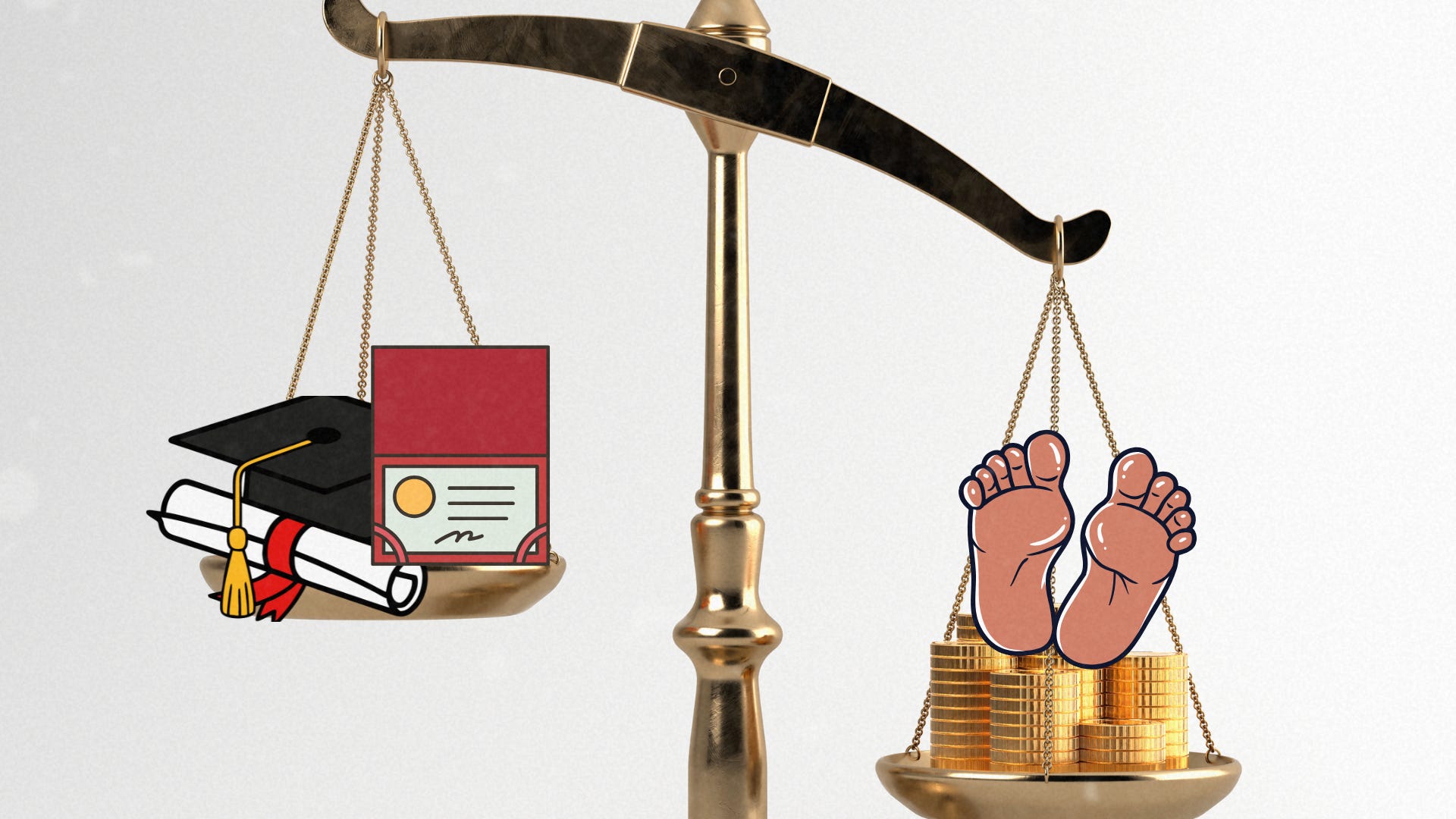
“Do well in school. Go to college. Get your degree. That’s your ticket.”
I heard some version of that sentence my entire life. From teachers. From adults who meant well. From people who genuinely believed it. It wasn’t framed as advice so much as inevitability. If you followed the steps, the outcome would follow.
College equaled opportunity. Stability. A good job. A life that made sense.
That promise wasn’t invented out of thin air. For decades, it worked. A college degree did separate people economically. On average, degree-holders earn more and experience lower unemployment than people without one.
But “on average” leaves a lot of people out of the picture.
Over time, more and more people did exactly what they were told. In 1980, fewer than one in five adults had a bachelor’s degree. Today, it’s well over a third. The credential scaled. The payoff didn’t. The degree stopped being a differentiator and became a baseline. Just another box to check before you could even enter the conversation.
I didn’t follow the script neatly the first time around. I took a longer route. Eventually, though, I went back to school. Earned the degrees. Bought into the idea that this would be the thing that settled everything. That the math would finally work.
Instead, the math stopped working.
Wages crawled. Housing sprinted. Student debt ballooned. Entry-level jobs began requiring credentials they never needed before. Even now, many recent graduates are underemployed and working jobs that don’t actually require the degrees they were told were essential.
It’s not that education is useless. It’s that the promise attached to it became outdated while we kept repeating it.
That disillusionment shows up in who we side-eye.
✦ Related: In 2026, I Will Be a Snitch
Recent surveys reflect what many people already feel. Fewer Americans believe a four-year degree is worth going into significant debt for, and nearly half say it matters less now than it used to. The promise broke, and instead of rewriting it, we started policing the people who stopped believing first.
That’s where OnlyFans creators enter the chat.
Not the food bloggers or gaming streamers. The ones selling access to their bodies. The people posting nudes. The digital sex workers who’ve taken the oldest profession and made it direct. They attract a particular kind of contempt — lazy, unserious, desperate — but the backlash isn’t really about morality. It’s about timing.
They figured out faster than the rest of us that the old guarantees were gone. That loyalty to a system that no longer delivers isn’t virtue; it’s just fear of what comes next. And being right too early carries a social cost. You don’t get praised for seeing the collapse ahead of time. You get dismissed. Ridiculed. Treated as if you failed to understand the rules, rather than recognized that the rules had already changed.
That kind of clarity is uncomfortable for people still trying to make the traditional path work. It forces a question no one wants to answer yet: if this no longer adds up, what am I still defending?
Sometimes, I feel that tension personally.
Not in an abstract way. But in a very real, very human way. I’ve caught myself feeling jealous of their decisiveness. Of opting out cleanly instead of lingering in a system that keeps moving the goalposts. I’ve joked, half-serious, about how often I’m told I have nice feet and how absurd it is that I’m not monetizing that fact.
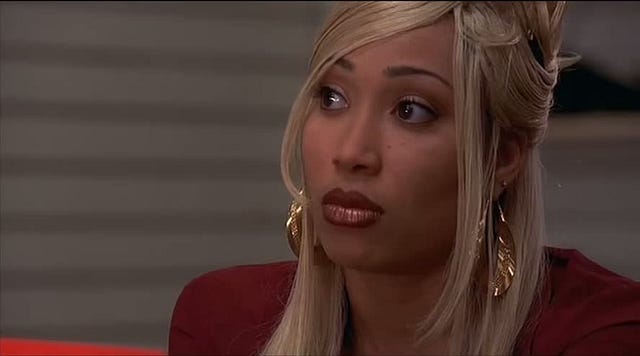
That’s when an old line from The Players Club starts echoing in my head: use what you got to get what you want.1
It’s usually framed as a punchline. Or a moral failing. But stripped down, it’s really just a statement about adaptation. About recognizing what the system rewards and deciding whether you’re willing to play by those rules — or keep pretending the old ones still apply.

I say all this to say that I understand the impulse now.
I understand why people look at the landscape, do the math, and opt out entirely. Why building something direct — audience to income, effort to reward — starts to feel less scandalous and more rational.
I’m not there yet.
But I’m close enough to admit why it makes sense.
Two seconds from OnlyFans. ⁂
The Players Club (1998), dir. Ice Cube. In this scene, Ronnie (played by Chrystale Wilson) is trying to recruit Diamond (LisaRaye McCoy) to work at the strip club where she works, dismissing Diamond’s retail job as “chump change.”
 Tiktok failed to load.
Enable 3rd party cookies or use another browser
✦ New here? Start with The American Experiment.